

Corporate Nutrition Reporting: Emerging Progress, Remaining Challenges
10 July 2026Corporate nutrition performance is emerging as a material topic within the food and beverage (F&B) sector. Transparency on how businesses influence nutrition is a critical lever to enable healthier societies.
Poor diets are among the leading risk factors for non-communicable diseases (NCDs), including obesity, diabetes, and cardiovascular conditions. They are also the leading cause of micronutrient deficiencies. Together, this translates into rising healthcare costs, reduced workforce productivity, and an increased economic burden on public systems.
Nutrition also directly affects companies through brand reputation and consumer trust, as well as regulatory risks and future compliance costs. Forward-looking companies that recognize nutrition as a material business issue are investing in their long-term success.
The Status Quo: Nutrition in Sustainability Standards
Despite its importance, nutrition remains only partially addressed in global sustainability reporting standards.
—
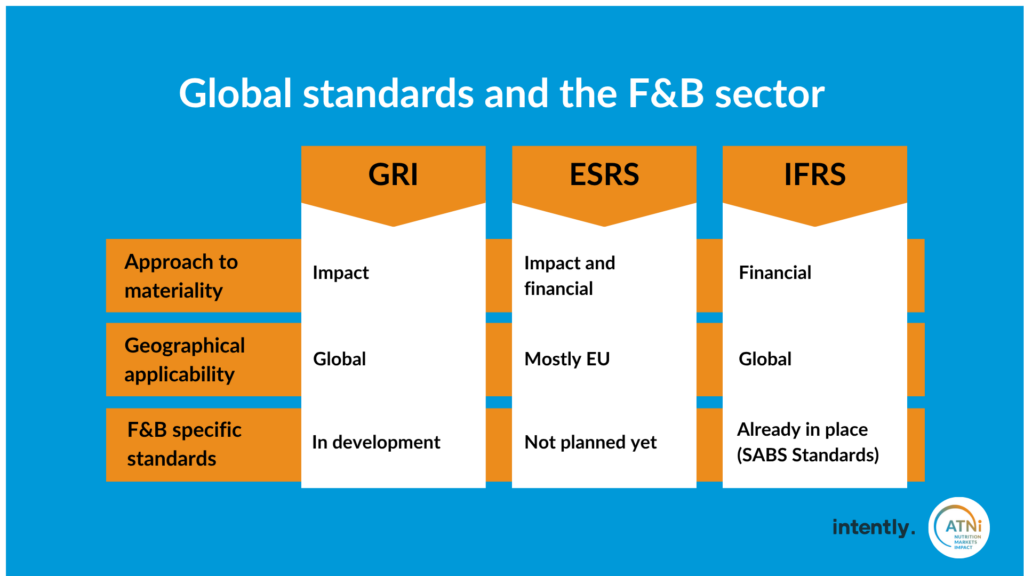
International Sustainability Standards Board (ISSB) / Sustainability Accounting Standards Board (SASB): This is the first standard to include disclosures specific to the F&B industry. It is applicable in jurisdictions that adopt International Financial Reporting Standards (IFRS), either as mandatory regulation or voluntary reporting standards.
- Opportunity: Includes concrete, nutrition-specific disclosures, (e.g. reporting on portfolio healthiness).
- Challenge: A strong focus on financial materiality means impact metrics (e.g. affordable nutrition) are missing. SASB standards are recommended under IFRS S1 and therefore not directly mandated.
Corporate Sustainability Reporting Directive (CSRD) / European Sustainability Reporting Standards (ESRS): EU-specific and mandatory for large companies (>1,000 employees). Smaller companies can follow the voluntary standard.
- Opportunity: A double materiality approach means that impacts on society should be reported. Category ESRS S4 (Consumers and End-Users) should prompt F&B companies to disclose nutrition data.
- Challenge: No detailed F&B sector-specific metrics have been defined yet, leaving significant discretion to companies on what to report under ESRS E4. The voluntary standard does not include reporting category Consumers and End-Users category.
Global Reporting Initiative (GRI): A globally recognized voluntary standard focusing on impact disclosures, with an F&B standard currently in development.
- Opportunity: Strong emphasis on impact materiality and ongoing work on the F&B standard.
- Challenge: As a voluntary standard, adoption by companies may not occur without external drivers.
—
While these global standards are informing developments across several jurisdictions worldwide, some countries may define their own country-specific standards and/or disclosures. ATNi is monitoring developments globally and across selected jurisdictions and is actively seeking opportunities to embed nutrition as a reporting dimension.
To date, ATNi has contributed to recent SASB consultations on the revised Processed Foods and Agriculture Products and Meat, Poultry and Diary standards.
There is a clear gap in existing standards when it comes to nutrition impact oriented indicators. These disclosures capture issues that do not yet directly translate into financial risks or opportunities for companies. However, financial materiality is dynamic: issues that seem non financial today can quickly become material, and if left unmonitored, may significantly affect a company’s bottom line.
One example is affordable nutrition. In 2024, 2.60 billion people were unable to afford a healthy diet. At the same time, the latest UN State of Food Security and Nutrition in the World report indentified food price inflation as an acute food systems issue.
While efforts by companies to ensure access to nutritious products can help to mitigate this, they do not always translate into immediate financial risks or opportunities. However, recent rollbacks to the SNAP program in the United States revealed that companies risk long-term financial returns when relying solely on social assistance programs to increase the affordability of their healthy products to low-income consumers. Additionally, public perception can shift rapidly, shaping consumer demand almost overnight, potentially leading to significant financial risks.
Data on the societal impacts of corporate nutrition practices is essential for policymakers shaping future regulations. High quality, comparable disclosures are critical to advancing broader public health outcomes. Evolving impact-focused standards, such as CSRD/ESRS and GRI, offer important opportunities to address this challenge.
Multistakeholder efforts are required to address challenges in the current landscape of nutrition disclosures in reporting standards, including:
Market players (Companies): Early movers adopting the standards can raise the bar for industry transparency, demonstrate feasibility, and influence peers through competitive pressure.
Investors: Shareholders and bondholders are well-positioned to demand standardized data on nutrition performance, with impact investors calling for impact-oriented disclosures.
Stock exchanges: When stock exchanges incorporate sustainability topics such as nutrition into voluntary national sustainability reporting standards, it signals to all capital market actors that the topic is material.
Auditors and Assurance providers: These actors help translate global reporting standards into national contexts, validate disclosures, advocate for nutrition as material topic, and develop company capacities to assess and report on nutrition.
Academia: Researchers can investigate the link between portfolio healthiness and financial returns and generate evidence that supports the continuous update of nutrition metrics.
Civil Society Organizations (CSOs): CSOs, including independent benchmarks and accountability initiatives, can continue to inform reporting standards, bring visibility to good practices and highlight cases of underreporting.
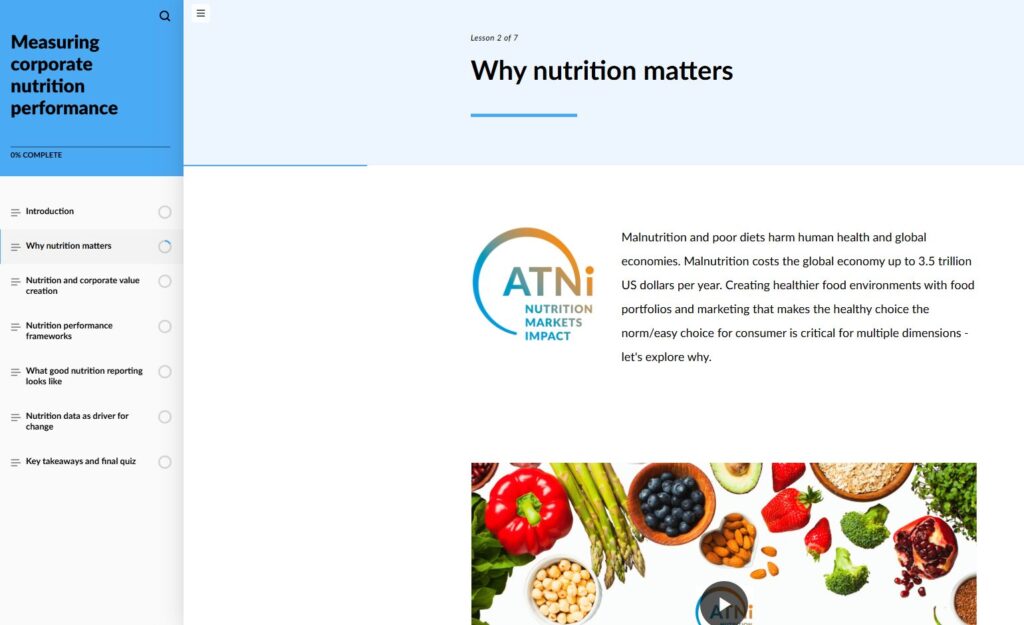
ATNi has developed a free, 15-minute E-Learning module, in collaboration with Intently, to support understanding of corporate reporting on nutrition and the role of different stakeholder groups [pictured above].
Conclusion: From Fragmentation to Accountability
Nutrition is gradually entering the corporate sustainability agenda, but progress remains focused on risk-oriented disclosures rather than forward-looking impact data. To move forward:
- Standards must balance financial and impact materiality.
- Ecosystem actors must actively drive demand, adoption and accountability for reporting on nutrition.
- Companies must be equipped with support and evidence of the materiality of nutrition.
Ultimately, measuring corporate nutrition performance is not just about reporting; it is about aligning business practices with healthier societies and more resilient economies.