


The case for mandatory front-of-package labels in the United States
15 December 2025In the United States (US), poor diets contribute to a public health crisis, with 37% of the population affected by some form of cardiovascular diseases, and 40% living with prediabetes. The Global Burden of Disease study estimates that dietary risks accounted for 357,575 US deaths from all non-communicable diseases in 2023.
The retail food environment plays a central role in shaping consumer choices. Highly processed, calorie-dense, nutrient-poor foods dominate food environments, and as demonstrated by ATNi’s Retail Assessment 2025 Pricing Analysis, often at lower cost than healthier alternatives.
FOP nutrition labels offer consumers basic nutrition information in a way that is easy to understand and allows them to compare different products quickly. Dozens of countries have adopted FOP nutrition labels to empower consumers to make healthier choices and prompt food manufacturers and retailers to offer healthier options.
What about voluntary FOP labels and industry self-regulation?
In the US, as in many other countries, the food industry has heavily lobbied for self-regulation and voluntary FOP labels instead of mandatory government initiatives. However, evidence from other countries shows that voluntary labelling is not working.
ATNi’s Global Index 2024, which assessed 30 of the largest food and beverage manufacturers worldwide, did not find evidence of any company comprehensively applying voluntary FOP labelling to all products across all applicable markets.
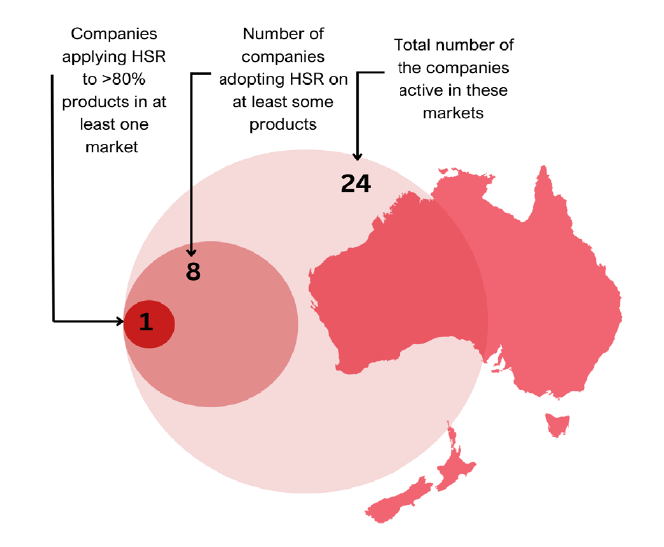
In Australia, for example, the voluntary health star rating (HSR) label was adopted in June 2014, with the intention that it would become mandatory if the voluntary approach was not successful. By 2024, only 37% of eligible products were found to display the label, marking a decline from 40.7% observed in 2019. In addition, ATNi’s Global Index 2024 found that of the 24 companies operating in Australia, only 1 company was applying HSR to more that 80% of its product portfolio, and 16 of the 24 companies were not applying HSR at all. After over a decade of voluntary measures, and roughly two-thirds of products failing to display an HSR, the Australian case shows that voluntary measures are often not uniformly adopted which substantially limits their potential to guide consumers’ choices. Voluntary FOP labels are also more commonly applied to healthier foods, with 54% of products with an HSR of 3.5 or high displaying a HSR compared to only 24% of products with an HSR of <3.
Such trends are also observed for other voluntary labels such as Nutri-Score, with some initial supporters such as Danone and Nestlé later withdrawing the label from some products or markets. These examples show a lack of uptake of voluntary measures which limits their effectiveness. While industry may initially express support for the label, this enthusiasm may decline if companies successfully circumvent mandatory regulations.

Currently, the US market has a confusing mix of different industry-developed labels. This includes ‘Facts Up Front’ (Grocery Manufacturers Association and Food Market Institute), ‘Clear On Calories’ (American Beverage Association), ‘Great for You’ (Walmart), ‘FoodHealth Score’ (Kroger), ‘Guiding Stars’ (Ahold Delhaize USA), among others. Many of these rely on their own proprietary rating systems, using different criteria and designs, but not formally benchmarked against any existing government-endorsed nutrient profiling model (NPM). Nutrient profile models offer a structured method for classifying or ranking foods and drinks based on their nutritional composition. While there are many types of NPMs, they usually consider the quantity of “healthier” ingredients (whole grains, fruits and vegetable) and less healthy ingredients, such as sugar, salt or saturated fat. They are used to distinguish healthier from less healthy products for purposes like FOP labelling, marketing restrictions and reformulation.
When each retailer uses a different model, it creates confusion for consumers and may contribute to health halo effects. A unified, government-mandated FOP label would bring much needed clarity. Such consistency would help all actors: consumers would be better able to compare products across retailers and quick make choices, investors would be able to quickly assess the overall healthiness of product portfolios, and manufacturers and retailers would not need to invest in developing their own systems.
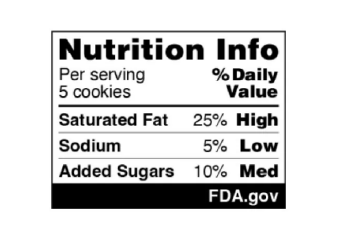
In January 2025, the FDA proposed a new rule that would require most packaged foods sold in the US to carry a mandatory FOP nutrition label — called the “Nutrition Info Box.” The label would highlight three nutrients of public health concern: added sugar, sodium, and saturated fat. For each nutrient, the proposed label would show whether a serving of the product is “High,” “Medium,” or “Low” in that nutrient, along with the percent of the recommended daily value (per serving).
The design is intended to complement the traditional Nutrition Facts label on the back or side of the package, giving consumers an at-a-glance summary of three nutrients that are commonly overconsumed and linked to adverse health outcomes, while preserving detailed nutrient breakdowns for those who want them.
We were interested to understand how industry responded to the FDA’s proposed FOP label. The responses indicate that while retailers, manufacturers, and industry associations have a range of opinions on the specific design of the label, there is now broad support for a government-led system. However, we urge the FDA to resist requests by some industry stakeholders for the label to be made non-interpretive, meaning one which simply provides information without evaluating that information. For example, a non-interpretive label might list the grams of sugar rather than specifying it is a relatively high amount, or with unjustifiable or confusing exemptions/different criteria for specific foods. For optimum impact of the label, it is crucial that it is a mandatory government initiative so that it is applied uniformly and comprehensively across all applicable products.
Decades of evidence from around the world shows that mandatory and standardized FOP labelling is an essential building block toward a healthier food retail environment. FOP labelling ensures consumers can make easy, informed choices about the healthiness of the foods they are purchasing, while also incentivizing reformulation by food manufacturers to achieve a more favourable label.
The idea of FOP nutrition labelling is not new—16 countries around the world have already implemented mandatory FOP systems, often with “warning” or “high in” labels for products high in sugar, salt, or saturated fat. Such labels are shown to be easier for consumers to understand, and have been show to support consumers in identifying healthier options.
In addition to supporting consumers identify healthier options, when companies know that sugar, sodium, and saturated fat levels will be plainly labelled—and easily comparable by consumers—there is a stronger incentive to reformulate products for better nutrient profiles. In Chile, mandatory warning labels have led to substantial reduction in saturated fats, sodium and sugar, as industry reformulates products so they will not need to carry a warning label. For example, breakfast cereals have reformulated so that now only 40% need to carry warning label, compared to 83% before the mandatory FOP label.
ATNi has been collaborating with Center for Science in the Public Interest (CSPI) to determine policy solutions for the challenges identified in ATNi’s US Retail Assessment 2025. CSPI has been advocating for FOP labels since 2006 and petitioned FDA to adopt a mandatory, interpretive FOP label in 2022. CSPI argues that FOP labels will be even more effective if they consider the significant and growing evidence base that “warning-style” “high-in” labels are most effective in changing consumer purchasing behaviour. A recent modelling study suggests that such labels could prevent approximately 100,000 deaths from diet-related non-communicable diseases in the US.
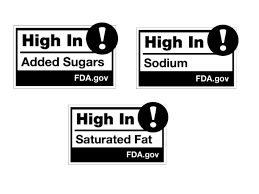
When food packages are covered in various nutrition and marketing claims, FOP labels can be harder to notice and use. CSPI specifically recommends a simple, straightforward, text-only (i.e. non-numeric) “high in” label with an exclamation point icon to draw consumer attention.
In addition, the FDA’s FOP labelling proposal excludes foods marketed for children under 4 years old. CSPI recommends that FDA increase the public health impact of the label by ensuring it also applies to foods developed specifically for infants and toddlers (6-36 months). Early childhood nutrition is crucial for healthy growth and development; however, research highlights that these products often contain high levels of added sugars, sodium and saturated fats.

In a US-specific study, 60% of assessed foods for young children failed to meet nutritional requirements of the World Health Organization’s nutrient and promotion profile model. Including commercially produced food for young children in the FDA FOP labelling system would ensure caregivers are able to make informed choices about the nutritional quality of the products they feed to their children.
Finally, in countries that have implemented “high in” nutrient warnings, some companies have started to replace some of the sugars in their products with low and no-calorie sweeteners. These non-nutritive sweeteners are not recommended for young children because long-term health effects associated with consumption in childhood are still unknown, and it has been suggested that early exposure may predispose children to prefer higher levels of sweetness in the diet. To avoid this unintended consequence of FOP labelling, CSPI also recommends that FDA require disclosures on foods containing non-nutritive sweeteners stating: “Contains non-nutritive sweeteners: not recommended for children.”
At ATNi, we believe a shift away from food environments dominated by highly processed, calorie-dense, nutrient-poor foods and towards a food environment where the healthy choice is the easy and affordable choice is essential. The introduction of government-endorsed, mandatory FOP nutrition labelling represents a foundational step towards healthier diets, greater transparency, and accountability in the US retail food environment.
Note: Special thanks to Eva Greenthal and the Center for Science in the Public Interest team for their helpful review and for providing data and resources on FOP labelling in the US.