
The French Nutrition and Climate Strategy 2030 – the key role of retailers in putting this into action
30 April 2026Unhealthy diets and high-food related emissions continue to undermine France’s health and sustainability goals. Modern food retailers, the primary food source for many French households, sit at the heart of this challenge and its solutions.
Low consumption of plant-based, fibre rich foods such as fruits and vegetables, whole grains and legumes have led to micronutrient deficiencies – with vulnerable populations, including women, children and low-income households, at disproportionately higher risk. At the same time 33 and 66% of French adults exceed weekly recommended quantities of red meat and charcuterie, as set by the French Public Health Authorities. Unhealthy diets have a substantial economic burden in France and have been estimated to result in €134 billion in hidden costs in 2023, including direct public health care costs, and indirect costs such as productivity losses.
These dietary patterns are not only unsustainable from a health perspective, but they also carry a significant environmental and climate footprint. Food consumption accounts for 24% of household greenhouse gas emissions (GHG) in France, with livestock production representing a particularly significant share, especially when chemical inputs to grow feed for livestock are taken into account. The hidden costs of these unsustainable food systems are also significant – estimated at €43 billion in 2023.
Transforming food systems so they deliver both nutrition, climate and environmental health are therefore urgently needed in France. This requires action across value chains, ranging from more sustainable production models, such as regenerative agricultural or agroecological approaches, to supporting dietary shifts that reduce reliance on animal products.
In response to growing nutrition, health and climate challenges, and to calls from citizens and civil society better align environmental and food policy, the – after more than two years of delay.
This strategy sets out the French government’s ambitions for 2030: to improve access to healthier and more sustainable food, whilst supporting French agriculture and food security. For the first time, it brings together food security, nutrition and climate priorities under one framework, linking the food-related action plans of each ministry, such as the Programme National Nutrition Santé (PNNS) and the Programme National de l’Alimentation (PNA), to broader health and sustainability goals. By 2030, the SNANC aims to reduce childhood overweight and obesity by 30% compared to 2015, and to cut GHG emissions by 50% relative to 1990 levels.
Despite this integrated vision, the SNANC lacks the specific, time-bound targets needed to drive meaningful change. For example, it encourages a gradual shift towards diets aligned with the PNNS: increasing fruit and vegetable and legume consumption, alongside limited consumption of red and processed meats, particularly imported ones (Objective 5). Actions to achieve this include supporting diverse protein sources, for example through developing the French legume sector by financing various territorial projects. However, no binding or quantified targets are set for reducing red and processed meat consumption.

A similar approach is taken under Objective 8 which aims to reduce marketing of foods considered unhealthy or environmentally unsustainable. Voluntary actions, such as displaying Nutri-Score or environmental labels on products are encouraged. The plan stops short however of proposing concrete restrictions on advertising to children – such as bans on marketing of products high in fat, salt or sugar surrounding schools, or on various media channels, such as television. As highlighted by the WHO, mandatory measures are considered most effective to reduce children’s exposure to unhealthy food marketing. Policymakers should draw on examples such as the UK, where regulations were recently introduced to prohibit advertising of less healthy products on TV (between 05.30 and 21:00) and online.
The SNANC also takes a cautious stance on ultra-processed foods (UPF). Referencing a recent report by the ANSES, the French National Agency for Food, Environmental and Occupational Health and Safety, the SNANC notes the risks of ultra-processed foods to be insufficiently defined. As a result, the Objective 19 proposes to advance research and further develop expertise around food processing, rather than introducing regulatory measures.
The roles of retailers in facilitating food systems transformations
Retailers have great capacity to contribute to nutrition and climate goals outlined in the SNANC, both though their roles in day-to-day consumer food purchases and through their engagement with actors across the value chain.
In France, modern retail formats, including supermarkets, hypermarkets and convenience stores, represent more than 90% of grocery sales. Retailers therefore have great influence over what consumers buy and eat, where decisions on product formulation and assortment, labelling, pricing and promotions shape consumer behaviour. However, their influence extends beyond the shelf. As major buyers and distributors of produce and packaged products, retailers engage frequently with producers, agri-food companies and manufacturers, who may be obliged to meet retailer standards on nutrition and sustainability.
The SNANC recognises the responsibility of the retailers and sets the objective of ‘establishing specific commitments on nutritional quality and sustainability in the retail sector’ (Objective 6). However, apart from a mandatory reporting on their sales of ‘sustainable and high-quality products’, no concrete measures are specified. The Strategy favours a consultative approach with retailers to “develop a national roadmap and a range of actions” aimed at increasing sales of sustainable products and those of higher nutritional quality.
Encouragingly, French retailers have recently expressed strong support for the SNANC in a recent press release. The Fédération du Commerce et de la Distribution (FCD), representing major retailers such as Auchan Retail, Carrefour, Coopérative U, Groupe Casino Monoprix, E.Leclerc and Intermarché, publicly welcomed the strategy. The FCD highlighted their commitments to improving access to sustainable, healthy and local food, called for the mandatory and widespread adoption of Nutri-Score and an environmental label, and acknowledged their role in supporting dietary transitions, such as the diversification of protein sources.
Gaps in retailers’ contributions
While retailers’ endorsement of the SNANC is a positive step, significant gaps remain in their current commitments and practices related to nutrition, climate and environment sustainability. Recent analyses from ATNi, Climate Action Network (CAN) France as well as Questionmark’s Superlist show a consistent picture: French retailers can and should do much more to drive meaningful change.
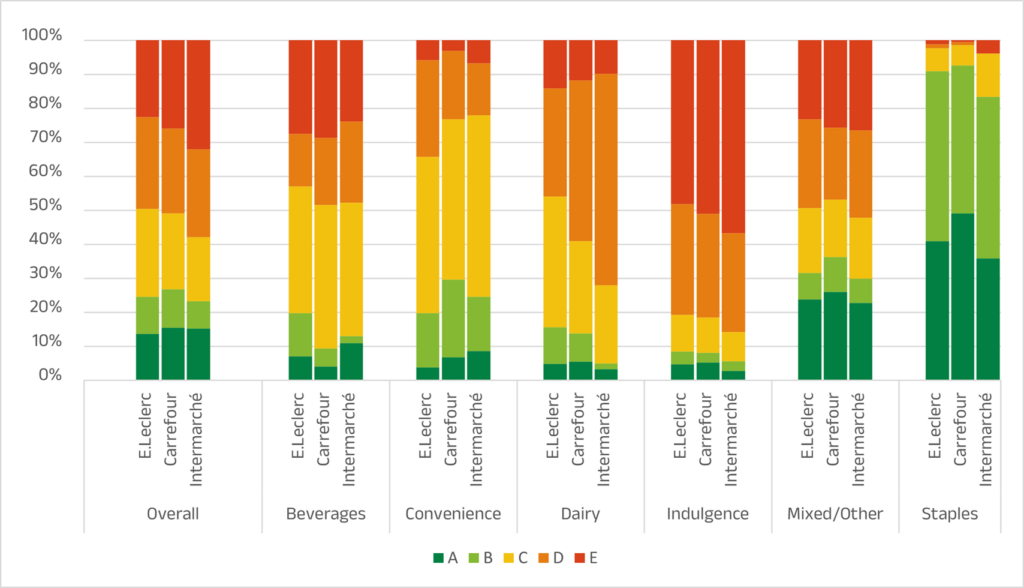
ATNi’s 2026 France Retail Assessment highlighted how French retailers have much opportunity to contribute to nutrition through their product formulation, and promotions. Analysis of Carrefour, Intermarché and E.Leclerc’s private-label products showed that only 27% of these retailers’ private-label products met criteria to be considered healthy (Nutri-Score A+B). Almost all products across the three retailers with high levels of fat, salt and sugar (HFSS) also contained cosmetic additives (84%), or markers of ultra processing (UPF), such as colourants, flavourants and non-nutritive sweetners.
Promotional practices showed similar misalignment with nutrition ambitions. Analysis of biweekly promotional flyers highlighted that less than one quarter of flyer space was allocated to the promotion of ‘healthy’ products. Flyers were found to be dominated by sweets and ice creams, refined grains, baked good and snacks. Analysis by CAN France, Foodwatch France and France Assos Santé similarly found that that 66% of the items promoted in flyers contradict French dietary guidelines, including HFSS products, as well as red meat and processed meat.
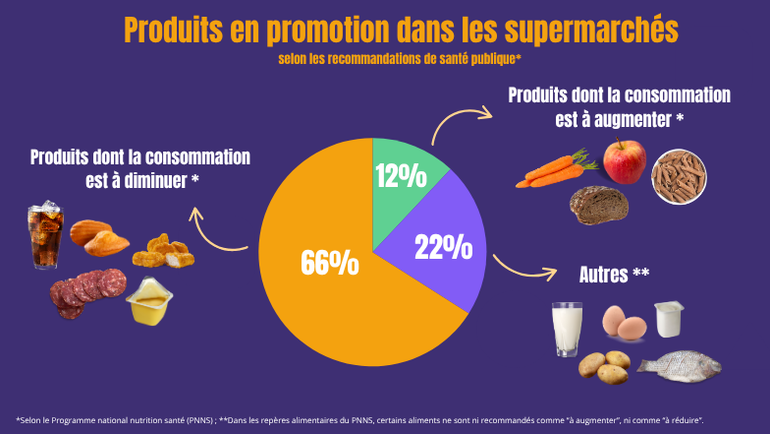
Climate and environmental reporting also lag behind what is needed. CAN France’s benchmark of eight major French retailers found limited transparency in reporting on GHG emissions, few commitments to reduce emissions and sales of unsustainable products as well as significant gaps in the promotion of sustainable products. At the same time, the Superlist 2026 benchmark showed how French retailers are failing behind their European peers, particularly on protein transitions and GHG emissions.
Together, these assessments highlight clear opportunity. While French retailers recognise the need for aligned nutrition and climate action, and national frameworks, their actual product portfolios, promotional strategies and climate commitments remain insufficient.
How can retailers lead in achieving the ambitions of SNANC?
Given their central role in shaping food environments, retailers can lead in turning SNANC’s ambitions into measurable progress. Many of the actions highlighted by the recent press release by the FCD point in the right direction. Setting specific, quantitative and time-bound goals and targets for achieving the FCD’s ambitions surrounding labelling, nutritional quality, environmental impact and dietary transitions, should be a priority.
Considering the France Retail Assessment, CAN France and Superlist findings, retailers can prioritise setting clear goals for product reformulation or diversification of assortment toward more sustainable options. This includes targets to reduce fat, salt and sugar content in high-volume categories, such as convenience foods and beverages, as well as targets surrounding protein transitions – for example increasing the share of healthier, plant-based ready meals.
However, major gaps remain in both the SNANC and current retailer commitments surrounding regarding promotions, as well as marketing and advertising, particularly to children. Given the lack of mandatory measures, retailers can lead by adopting policies to prohibit marketing of less healthy products to children. This could include for example, prohibiting the advertising of Nutri-Score C, D and E products to children under the age of 18 years. Retailers that act early on these issues also stand to benefit in terms of consumer trust, regulatory goodwill and alignment with sustainability expectations are increasingly competitive advantages in the French retail market.
With 2030 approaching, the window of meaningful action is narrowing. Retailers have both the scale and the influence to accelerate France’s nutrition and climate transition- not by waiting for mandatory measures, but by leading and getting ahead of them. The SNANC provides the direction; retailers must now match it and build on it with concrete, time-bound commitments.
